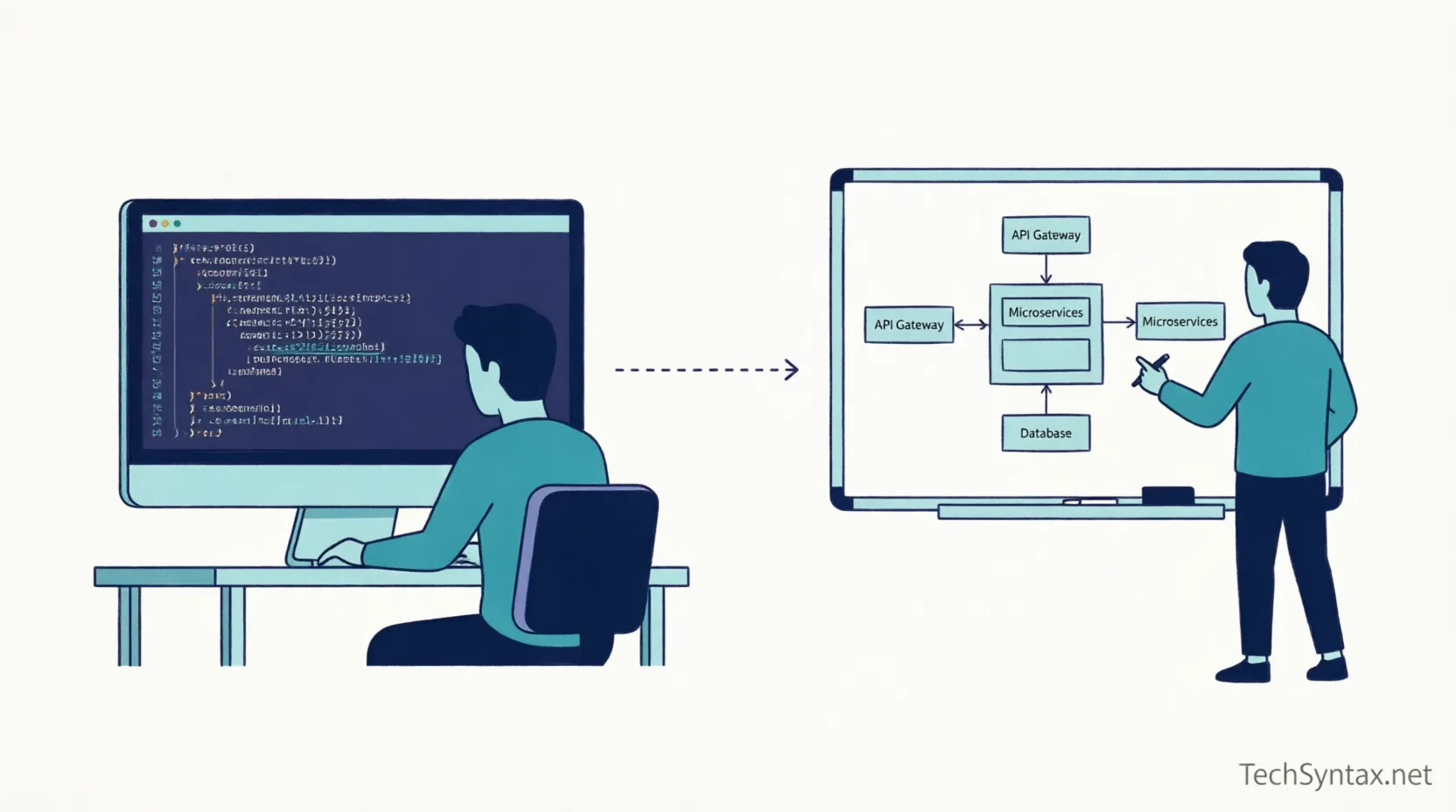
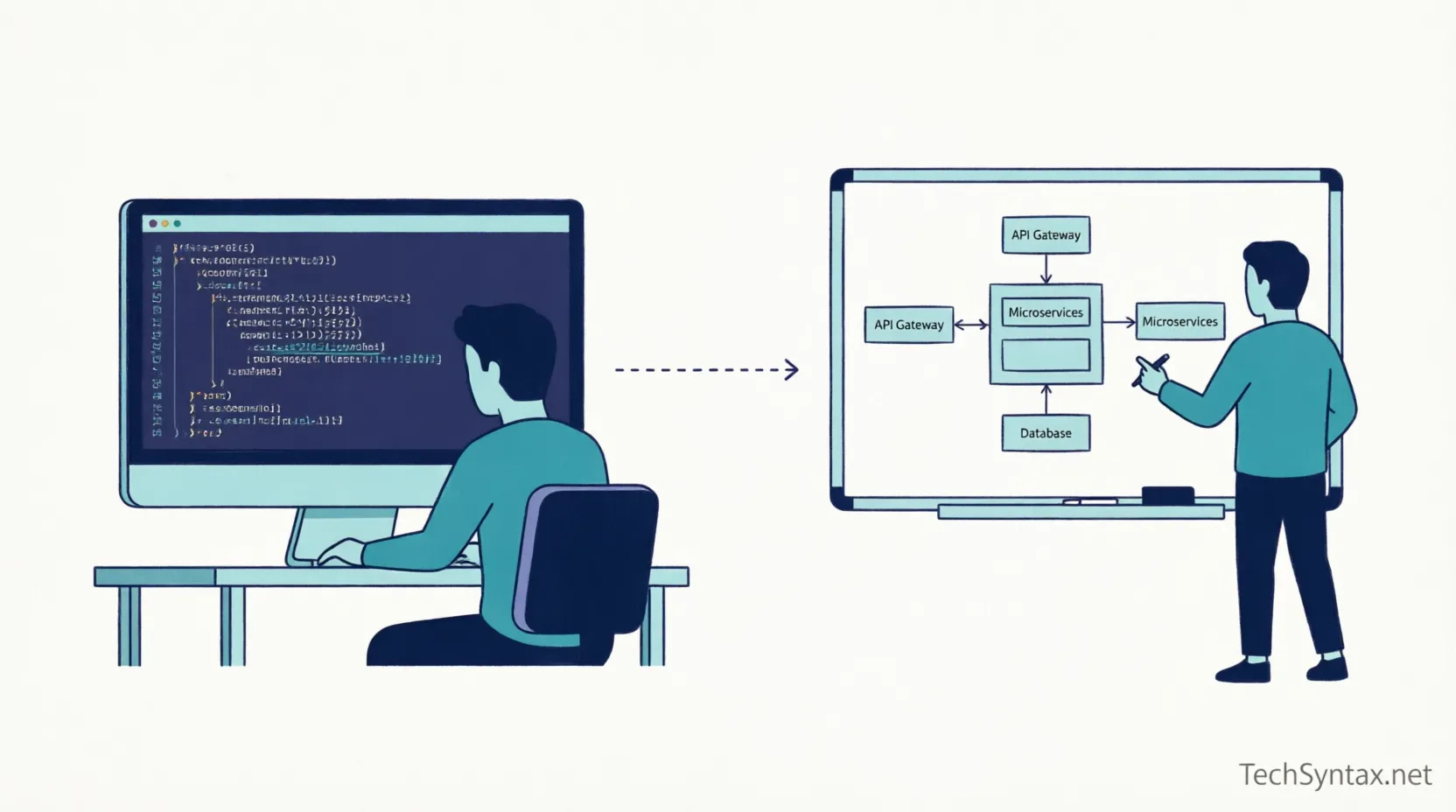
From .NET Dev to Architect: The Real Transition | TechSyntax
From .NET Developer to Software Architect: The Real Transition
Most senior .NET developers who want to become architects believe the path is simple: write better code, know more patterns, get the title. I believed that too. Then I spent two years as the de facto architect on a payment processing platform at a major bank — and realized the gap is almost nothing like I expected.
It is not a technology gap. It is a thinking gap. And closing it requires deliberately breaking habits that made you a great developer.
This is the article I wish had existed when I was making that transition. No career fluff, no "top 10 skills" lists. Just what actually changes, where most .NET developers fail, and a concrete path forward.
What actually changes when you become a software architect
Going from .NET developer to architect is not about knowing more technology. It is about changing what you optimize for. Here is the core shift:
- Developers optimize for correctness. Architects optimize for survivability under unknown future conditions.
- Developers own their component. Architects own the boundaries between components.
- Developers resolve ambiguity with code. Architects resolve ambiguity with documented decisions that others can trust.
- Developers measure success by passing tests. Architects measure success by systems that degrade gracefully under load, failure, and changing requirements.
- Developer skill is deep and local. Architect skill is wide, cross-cutting, and systemic.
The two traps that keep senior developers stuck
Trap 1: Believing depth will carry you
After years of mastering async/await internals, Entity Framework query plan optimization, and C# memory allocation patterns, it feels logical that the next step is knowing even more. So developers chase the next certification, dive deeper into .NET runtime internals, or become the team's expert on gRPC and SignalR.
None of that is wrong. But architecture selection has almost zero correlation with technical depth in a single stack. I have seen architects who could not write a LINQ query make systemically better decisions than senior developers who could recite the CLR garbage collector internals verbatim — because those architects understood tradeoffs across the entire system boundary, not just within one service.
The developer who knows C# best is not the architect. The architect is the person who can look at your entire C# codebase and tell you whether you even needed it to be C# at all.
Trap 2: Waiting for the title before acting like one
I see this constantly. Developers believe that once they are promoted to architect, they will start making architectural decisions. In practice, it works the opposite way. You get the title after people have already started trusting your judgment at the architectural level.
The transition is behavioural before it is formal. Start writing Architecture Decision Records before anyone asks you to. Start raising cross-service concerns in design reviews. Start quantifying non-functional requirements when the team hand-waves them. Do this for six months and the title usually follows.
What architects actually own — and what they do not
The mental model most developers carry is: architect = senior developer who designs systems instead of implementing them. That is partially right and mostly misleading.
| What architects actually own | What most devs think architects do |
|---|---|
| Service boundaries and how they evolve over time | Draw boxes on whiteboards |
| Non-functional requirements: latency SLAs, throughput targets, recovery time objectives | Choose the "right" framework or ORM |
| Technology selection with documented reasoning and explicit exit criteria | Stay current with new tech and recommend it |
| Failure modes and degraded-operation strategies | Review pull requests for correctness |
| The cost of complexity — when simplicity is the better architecture | Make systems more sophisticated |
| Cross-team technical alignment and communication | Be the smartest person in the room |
One thing that surprised me early on: architects say no far more often than developers do. A developer's instinct is to solve every problem with a technical solution. An architect's instinct is to question whether the problem itself is real, whether the proposed solution adds more complexity than the problem is worth, and whether a simpler system that does 80% would actually be better.
The technical skills gap — what you are probably missing
Let us be specific. Most senior .NET developers have strong command of their service's internals. The gaps I consistently see are systemic and cross-cutting.
1. Non-functional requirements as first-class constraints
In most .NET projects, performance is something the team addresses after functional requirements are done. An architect embeds NFRs into the design before a line of code is written.
Concretely: before committing to any service topology, an architect must be able to answer:
- What is our p99 latency budget for this request path, end to end?
- What is our maximum acceptable Recovery Time Objective (RTO) and Recovery Point Objective (RPO) per service?
- At what message volume does this queue topology start backing up, and what is our circuit breaker strategy at that point?
- What happens to user data if this service is unavailable for 30 minutes?
If you cannot answer those questions for the systems you work on today, that is your starting point — not learning a new pattern.
2. System design beyond component design
.NET developers are typically excellent at designing within a service: clean architecture layers, separation of concerns, solid CQRS implementation. The gap is designing across services. This includes:
- Data ownership. Which service is the source of truth for a given entity? What happens when two services need the same data?
- Distributed transactions. How do you maintain consistency when a payment record and an audit log need to be written atomically across two services?
- API versioning strategy. How do consumers evolve independently from providers without a deployment lockstep?
- Choreography vs orchestration. When does an event-driven choreography become undebuggable, and when does a Saga orchestrator save your team from madness?
3. Technology selection under uncertainty
Developers often evaluate tools by asking: is this the best tool for the job? Architects ask a harder question: is this the best tool given what we know today, what we are likely to need in 24 months, and the team's ability to operate it in production?
In a project I worked on, the team wanted to adopt Kafka for event streaming between four internal services. It was technically the right tool. But the ops team had zero Kafka experience, we had no Kubernetes cluster yet, and the traffic volume was 300 events per minute. We chose Azure Service Bus instead. Not as elegant. But we shipped on time, the team could operate it, and we had documented the decision so clearly that six months later, when we re-evaluated, the context was still fully readable.
That documentation — called an Architecture Decision Record — is one of the most underrated architect skills.
# ADR 012: Message broker selection for payment event pipeline

## Status
Accepted (2024-03-15)

## Context
Four internal services need to emit and consume payment lifecycle events
(created, authorized, settled, failed). Peak volume: ~300 events/min.
Team has no Kafka operational experience. No Kubernetes in prod until Q3.

## Decision
Use Azure Service Bus (Standard tier) with topic-based routing.

## Consequences
- Positive: operational simplicity, managed scaling, team-familiar tooling
- Negative: limited consumer group semantics vs Kafka; replay limited to 14 days
- Exit criteria: if sustained volume exceeds 10k msg/min or replay window
  becomes a business constraint, revisit Kafka/Event Hubs

## Alternatives considered
- Kafka on AKS: rejected — ops risk, timeline risk, premature optimization
- RabbitMQ: rejected — self-managed, no cloud SLA, no team familiarity
Notice what this ADR does: it captures the reasoning under current constraints, not just the decision. In 18 months, when the team inherits this system, they do not have to reverse-engineer why Service Bus was chosen. They can evaluate whether the exit criteria have been met.
.NET architecture patterns you must master in production — not in theory
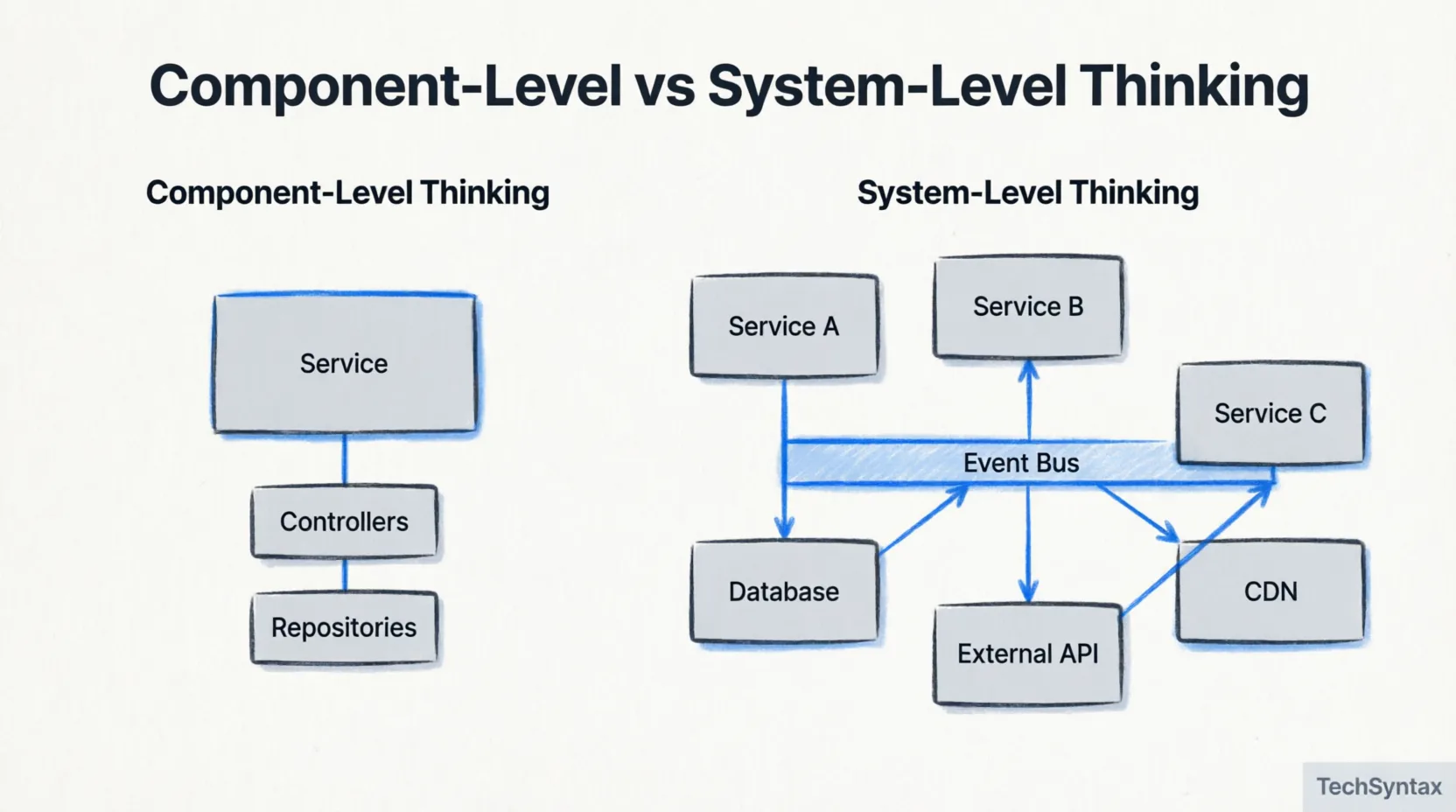
Every senior .NET developer knows Clean Architecture, CQRS, and the Outbox pattern from blog posts. Architects know where each one fails in production.
Clean Architecture: the organisational problem it hides
Clean Architecture is almost universally cargo-culted in .NET. Teams adopt the folder structure without understanding the dependency rule, and end up with four layers that all know about each other anyway, plus an abstraction layer that adds friction with zero architectural benefit.
I have seen a project where the domain layer had a direct reference to an EF Core entity because "it was just easier." At that point you do not have Clean Architecture. You have Clean Architecture Theatre — you pay the complexity cost without getting the testability or flexibility benefit.
An architect's job is to decide when Clean Architecture's cost-benefit makes sense (complex domain with heavy business rules, long-lived product, multiple delivery mechanisms) versus when a well-structured single-layer API is the better system (simple CRUD service, short lifetime, one client).
MediatR / CQRS: the handler sprawl problem
MediatR is the default in most .NET codebases today. And in many of them, it is a mistake. The library solves the "fat controller" problem by introducing the "everything is a handler" problem.
// What teams end up with — 200+ handlers, no discoverability
public class CreatePaymentCommandHandler : IRequestHandler<CreatePaymentCommand, PaymentResult>
{
    // Dependencies injected: IRepository, IValidator, IEventBus,
    // IAuditLogger, INotificationService, ICurrencyConverter...
    // The handler is now just a fat controller with extra indirection
}
CQRS as a pattern is valuable when reads and writes have genuinely different scaling or consistency requirements. It is not a universal default. An architect evaluates: do we have read-heavy vs write-heavy asymmetry? Do we need different consistency models per side? If the answer is no, adding CQRS adds ceremony without benefit.
The Outbox pattern: where most implementations break
The Outbox pattern solves distributed transaction consistency between your database write and your event publication. In theory it is straightforward. In production, three things consistently break implementations:
- The relay is a single process with no leader election. When you have multiple API instances, all of them poll the outbox table and you get duplicate event delivery unless you implement idempotency downstream — which most teams forget.
- The outbox table grows indefinitely. No archival or cleanup process, so after six months you are querying a 50-million-row table with no partitioning.
- Clock skew causes ordering surprises. If you sort outbox rows by
CreatedAtand your API instances have different clocks, events replay out of order. Use a monotonic sequence column instead.
-- A production-ready outbox table schema in SQL Server
CREATE TABLE OutboxMessages (
    Id          BIGINT IDENTITY(1,1) PRIMARY KEY,
    MessageType NVARCHAR(255)  NOT NULL,
    Payload     NVARCHAR(MAX)  NOT NULL,
    CreatedAt   DATETIME2(7)   NOT NULL DEFAULT SYSUTCDATETIME(),
    ProcessedAt DATETIME2(7)   NULL,
    Error       NVARCHAR(2000) NULL,
    -- Partition by processed state for relay query performance
    INDEX IX_Outbox_Unprocessed (ProcessedAt, Id) WHERE ProcessedAt IS NULL
);
-- Separate archival job moves processed rows older than N days
Feature flags over big-bang releases
This is an architectural decision many developers do not even recognize as architectural. Using feature flags to decouple deployment from release is a system design choice that affects your team's deployment cadence, your ability to do canary releases, and your incident recovery time.
In .NET, Microsoft.FeatureManagement integrates cleanly with configuration and Azure App Configuration. But the architectural question is not "how do I implement feature flags?" It is: "what is our flag lifecycle policy, who owns flag retirement, and how do we prevent flag accumulation from making the codebase unmaintainable?"
How architects think differently about decisions
The clearest difference between a senior developer and an architect is not what they know. It is how they frame decisions. Developers frame decisions in the present tense: what is the right solution for this problem right now? Architects frame decisions across time: what will the cost of this decision be in 18 months, under load, when the team has changed?
Two tools that force this shift:
The ATAM-style tradeoff question
Before committing to any significant architectural decision, ask: "What quality attribute does this optimise for, and what does it sacrifice?" Every architectural decision is a tradeoff. A microservices topology optimises for team autonomy and independent deployability — but sacrifices observability simplicity and increases distributed systems complexity. A monolith optimises for simplicity and consistency — but sacrifices independent scaling and deployment isolation.
If you cannot articulate both sides of the tradeoff clearly enough for a non-technical stakeholder to understand the risk, you are not ready to make the decision.
The reversibility test
Jeff Bezos's two-door decision framework applies directly to architecture. Before every significant decision, classify it:
- Reversible (Type 2): Can be undone with one sprint of effort. Move fast. Examples: picking a logging library, adding a middleware layer, choosing a DTO mapping approach.
- Irreversible (Type 1): Structural coupling that cannot be unwound cheaply. Move slowly, document thoroughly, involve the team. Examples: schema ownership boundaries, event contracts between services, authentication token format.
Most senior developers apply the same caution to both. Most architects spend their attention on Type 1 decisions and delegate Type 2 confidently to the team.
The communication gap: the skill nobody talks about
I will be direct: this is where most technically strong developers fail the transition. Not on system design. On communication.
An architect operates at the intersection of three audiences simultaneously:
- Engineering teams — who need precision, code-level rationale, and respect for their autonomy
- Product and business stakeholders — who need risk framing, cost implications, and timelines
- Other architects and tech leads — who need rigorous technical justification and alignment
The mistake most developers make is using one register for all three audiences. They present a database schema choice to a product manager with the same level of technical detail they would use in a code review. The result: the product manager thinks the architect is speaking a foreign language, and the architect thinks the product manager does not care about quality. Both are wrong.
"We are storing payment events in a separate append-only table with a filtered index on unprocessed rows. This lets us publish events reliably even if the message broker has a transient failure, which protects us from double-charging customers."
That is how you explain the Outbox pattern to a product manager. Not by naming it. By connecting it to their concern: customer trust and financial accuracy.
Practice this deliberately. After every technical decision, write two versions of the explanation — one for engineers, one for stakeholders. Do this for three months and the translation becomes natural.
Building your architecture portfolio as a .NET developer
You cannot get an architect role without demonstrating architectural thinking. But you likely do not have a formal architect title yet. Here is how to build evidence without one.
1. Own an Architecture Decision Record backlog
Start writing ADRs for decisions that are already made — not just future ones. Document why your team uses EF Core instead of Dapper, why the current service boundaries are where they are, and what assumptions those decisions rest on. This is valuable immediately, and it demonstrates architectural thinking visibly.
Use a simple format: context, decision, consequences, alternatives rejected. Keep them in version control alongside the code. Make them searchable.
2. Run one architectural review that you initiate
Pick a real current-state pain point — a service that is too coupled, a data model that is causing cross-service inconsistency, a deployment process that is too slow. Write a short RFC (Request for Comments) document: current state, problem definition, proposed change, alternatives considered, risks and open questions. Share it for feedback.
You are not solving a problem for the sake of it. You are demonstrating that you can operate at the architectural level without being asked.
3. Benchmark something non-obvious
Architects are trusted partly because they do not make claims without evidence. Pick a performance assumption your team holds — "EF Core is too slow for this query," or "serializing with System.Text.Json is fast enough for our payload size" — and benchmark it properly using BenchmarkDotNet. Write it up. Share it. Decisions backed by measured data carry far more weight than decisions backed by intuition.
[MemoryDiagnoser]
[SimpleJob(RuntimeMoniker.Net80)]
public class SerializerBenchmark
{
    private readonly PaymentEvent _payload = new PaymentEvent { /* ... */ };

    [Benchmark(Baseline = true)]
    public string NewtonsoftJson() =>
        Newtonsoft.Json.JsonConvert.SerializeObject(_payload);

    [Benchmark]
    public string SystemTextJson() =>
        System.Text.Json.JsonSerializer.Serialize(_payload);

    [Benchmark]
    public string MessagePack() =>
        Convert.ToBase64String(
            MessagePackSerializer.Serialize(_payload));
}
// Results shape the conversation about wire format for 50k msg/min scenarios
A realistic 12-month roadmap
This is not a reading list. Reading architecture books will not make you an architect any more than reading cookbooks makes you a chef. This is an action roadmap.
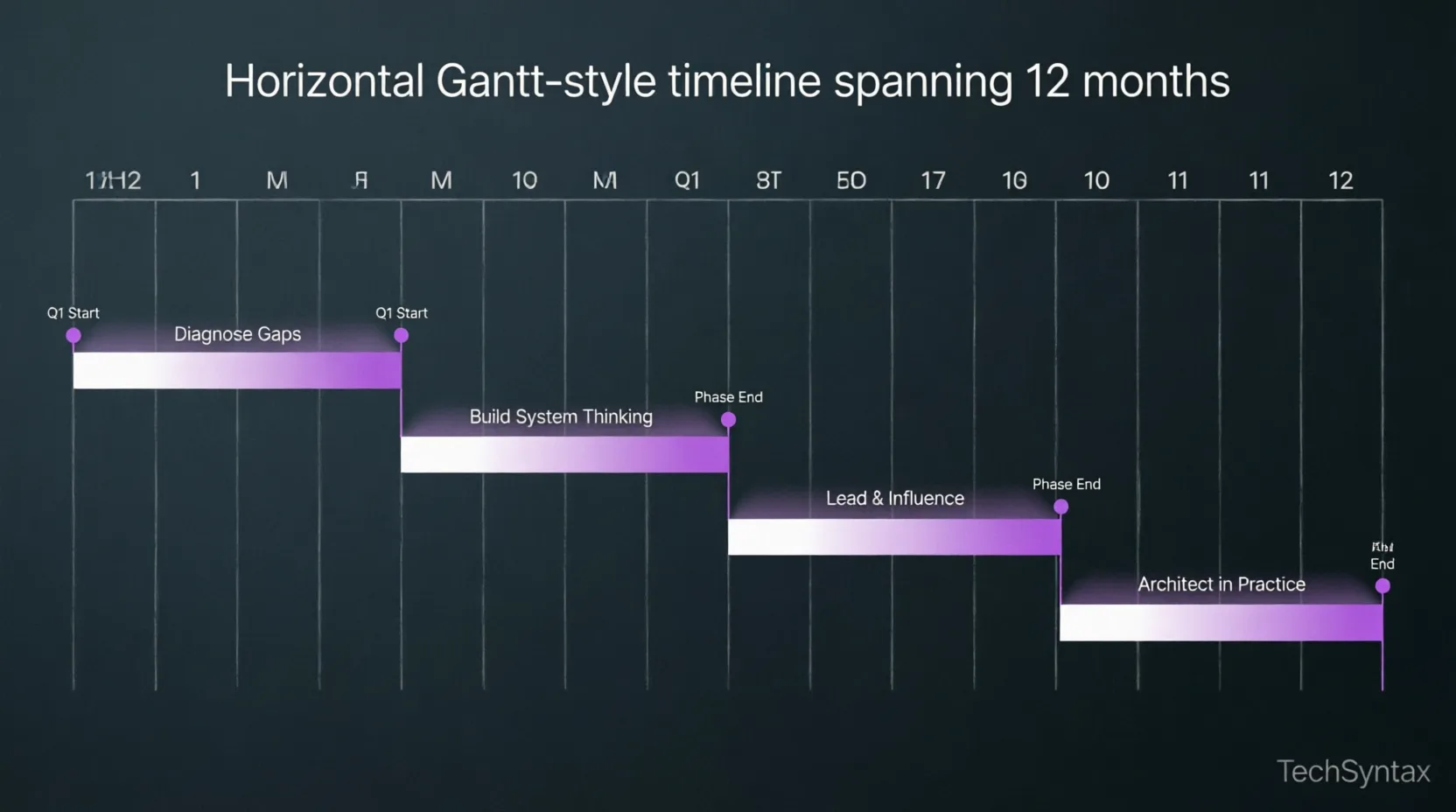
Months 1–2: Diagnose your actual gaps
- For every service you work on, document its NFRs — latency, throughput, RTO, RPO. If they do not exist, create a first draft with the team.
- Shadow your current architect (or the most system-aware person on your team) in design discussions. Take notes on what questions they ask that you would not have asked.
- Audit the last three significant technical decisions made on your project. Could you articulate, in writing, why each was made and what was traded off?
Months 3–6: Build cross-service system thinking
- Read Designing Data-Intensive Applications by Martin Kleppmann — not cover to cover, but chapters on replication, partitioning, and distributed transactions. These directly apply to every multi-service .NET system you will ever work on.
- Draw the full system diagram for your current project — every service, every database, every external dependency. Include data flows and failure modes. Most developers have never done this for the system they work in every day.
- Write your first ADR for a real past decision. Share it with the team.
- Start consuming Azure Architecture Center and Microsoft's cloud architecture guidance — not as evangelism, but as a vocabulary for discussing architectural options.
Months 7–9: Lead and influence
- Initiate one architectural review. Write the RFC. Run the session. Document the outcome.
- Present a technical risk or architectural concern to a product manager or business stakeholder — in their language, not yours.
- Start conducting design reviews for junior and mid-level developers, focusing on cross-service concerns rather than code correctness.
- Contribute to one open-source .NET project's architectural discussion (issues, design proposals, or architecture docs). This builds portfolio evidence and trains you to reason about systems you did not build.
Months 10–12: Architect in practice
- Volunteer to lead the design of one new service or significant feature from inception. Document the full architectural rationale.
- Deliver a formal RFC or design document that goes through a review process and results in a team decision.
- Identify one area where your current system's architecture is creating friction (deployment, consistency, scalability) and propose a bounded improvement — not a rewrite, a targeted change with measurable success criteria.
Common mistakes to avoid
Mistake 1: Proposing rewrites
New architects almost always propose rewrites. Experienced architects almost never do. A rewrite is the option of last resort. It discards all the operational knowledge embedded in the existing system, carries massive delivery risk, and rarely produces the clean-slate system that was imagined. Architects earn trust by improving existing systems incrementally, not by declaring them dead.
Mistake 2: Solving problems that are not architectural
Not every problem is an architecture problem. A slow API endpoint might be a missing index, not a service topology issue. A missed deadline might be a planning failure, not a technology choice failure. Architects who reach for architectural solutions to non-architectural problems lose credibility fast.
Mistake 3: Making solo decisions
Architecture in a team context is consensus-building as much as it is technical analysis. An architect who makes decisions in isolation and announces them — no matter how technically correct — will create resistance, lose context, and miss constraints that the team holds implicitly. The RFC process exists precisely to make architectural decision-making collaborative.
Mistake 4: Optimising for elegance over operability
The most elegant architectural pattern is the one that your team can operate confidently in production at 2am when something breaks. I have seen beautiful event-sourced systems with CQRS and CRDT-based state that no one on the team could debug under pressure. Operability is a quality attribute. Weigh it accordingly.
Further reading
Internal links
- Cursor vs Windsurf vs GitHub Copilot (2026): Which Wins
- Monolith vs Microservices 2026: .NET Senior Dev Guide
- Kimi K2.6 vs Claude Opus 4.6: Why Developers Are Switching
- Building AI-Powered Backends with .NET 11
Official references
- Azure Architecture Center — Microsoft
- .NET Application Architecture Guidance — Microsoft
- Azure Well-Architected Framework — Microsoft
About the author: Adem Zeina is a senior .NET and backend engineer with over a decade of experience in financial services systems, including enterprise banking and payment platforms. He writes about .NET, C#, backend architecture, and AI tooling at TechSyntax.net.
Be the first to leave a comment!